© Tóth Tamás


PraiseProjector 2.0 is one unified application available as desktop packages for Windows, Linux, and macOS, from Google Play on Android, and in a browser or as a PWA. Within the same application, you can switch between the full workspace and the focused client view.
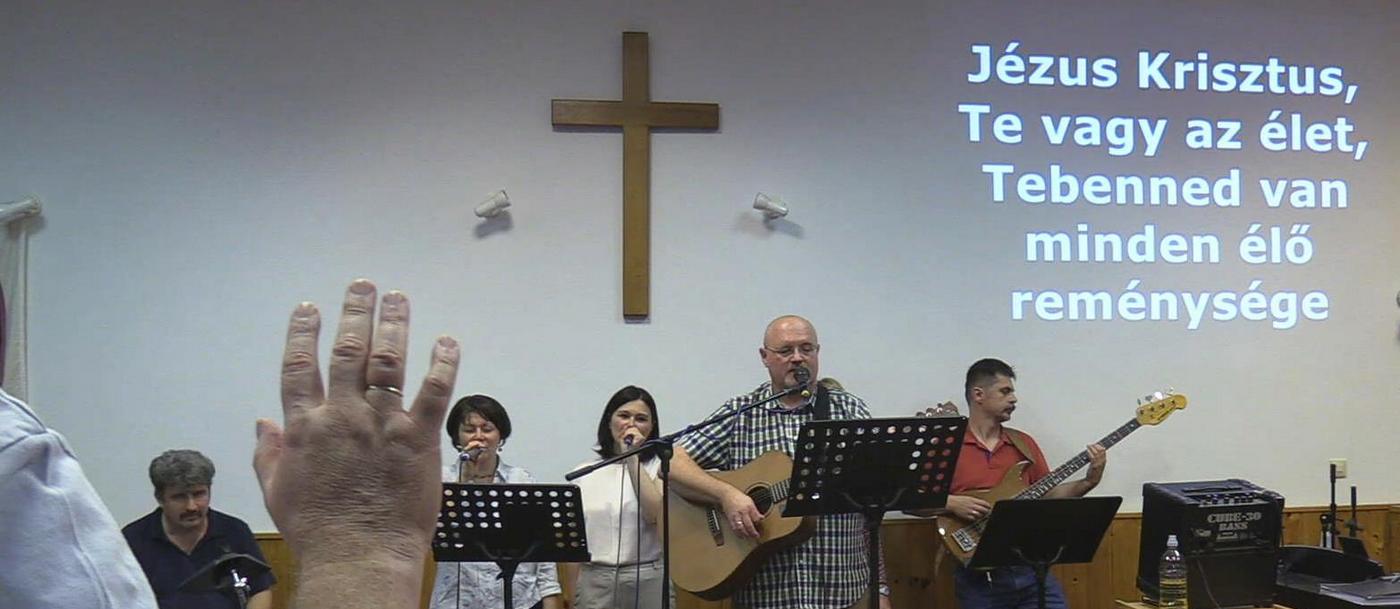
PraiseProjector is a free solution primarily for Christian congregations to edit, store, and share songs, while musicians can view lyrics and chord progressions, and the text can be projected for the congregation or audience.
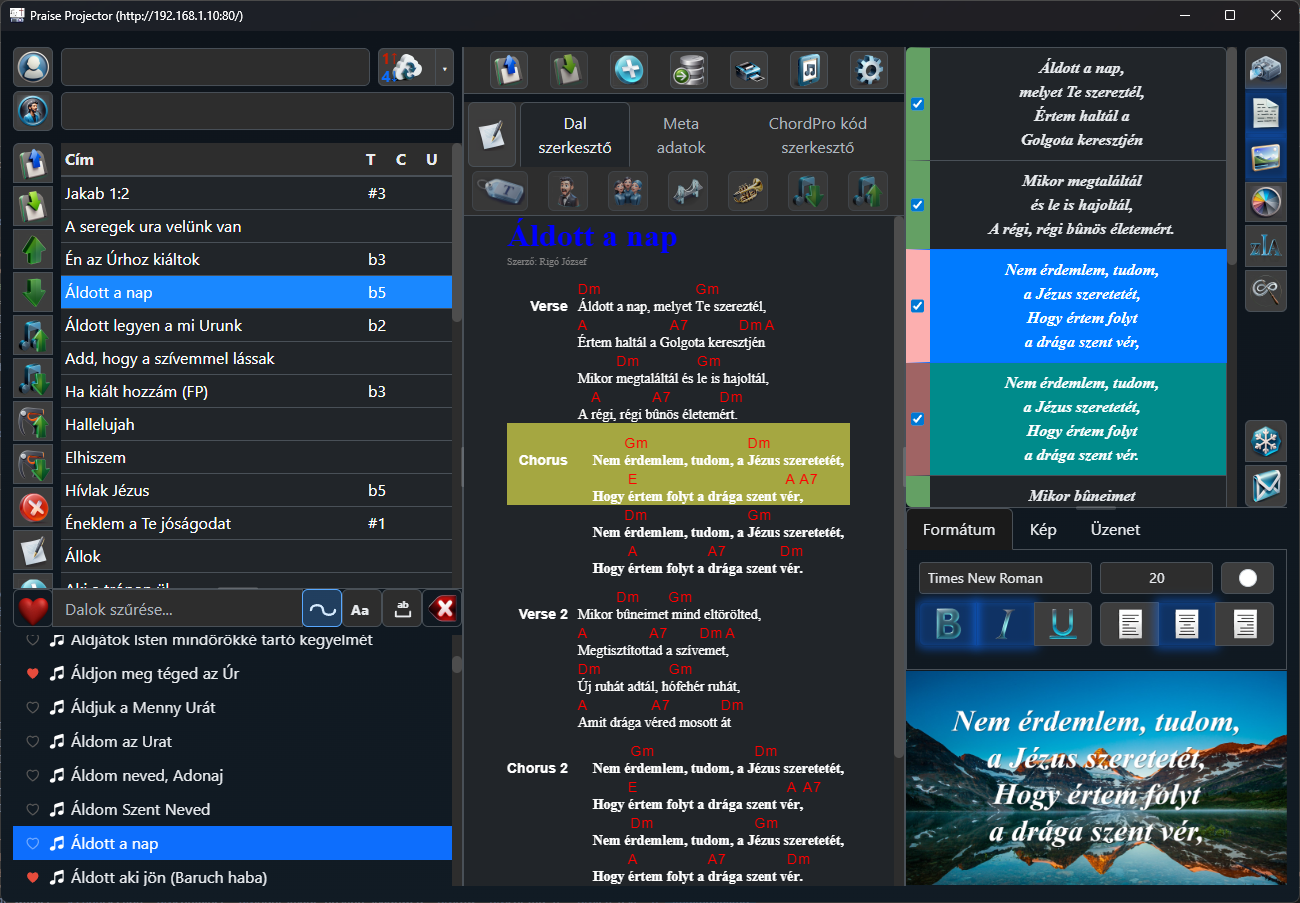
The full view provides a comprehensive workspace for editing, projection, and database management, while the client view is optimized for mobile screens, musicians, following, and joining sessions. They are views of the same PraiseProjector application, not separate apps.
The PraiseProjector web application also works as a PWA in modern browsers, so installation is often unnecessary. A QR code opens the same application in the appropriate client view for quickly joining a session.
 There are already many tools for projecting worship lyrics, and many of them are free. So why build another one?
PraiseProjector stands out from similar applications in two key ways:
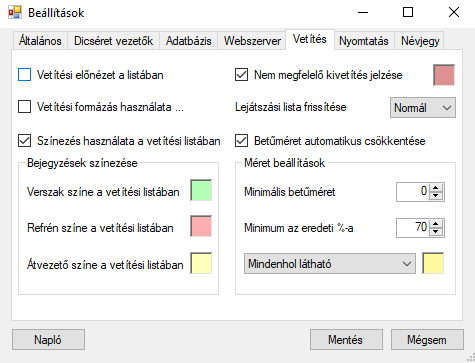 PraiseProjector automates as much of the projection workflow as possible.
There is no need to manually format or split lyrics for projection; setting the font family and size is usually enough.
The app automatically reflows text and shows clearly separated sections. It can also reduce font size when needed for better layout, and it warns you when a lyric may cause projection issues.
Of course, you can still customize background images, text color, style, outlines, and more, but PraiseProjector is primarily designed for simplicity and ease of use. For example, song search also supports "similar word" matching.
PraiseProjector automates as much of the projection workflow as possible.
There is no need to manually format or split lyrics for projection; setting the font family and size is usually enough.
The app automatically reflows text and shows clearly separated sections. It can also reduce font size when needed for better layout, and it warns you when a lyric may cause projection issues.
Of course, you can still customize background images, text color, style, outlines, and more, but PraiseProjector is primarily designed for simplicity and ease of use. For example, song search also supports "similar word" matching.
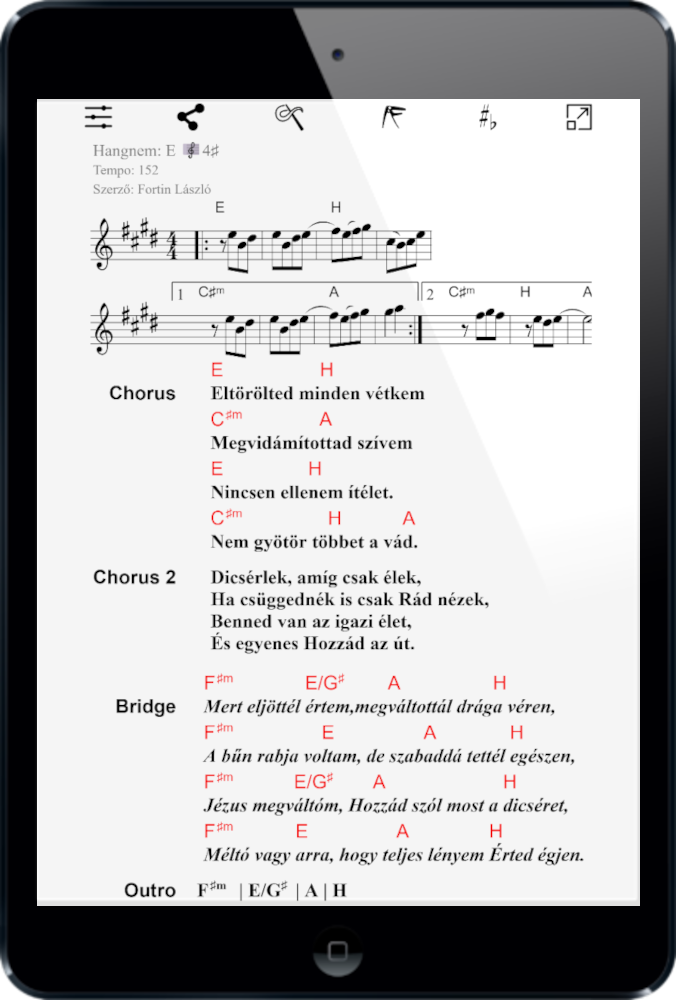
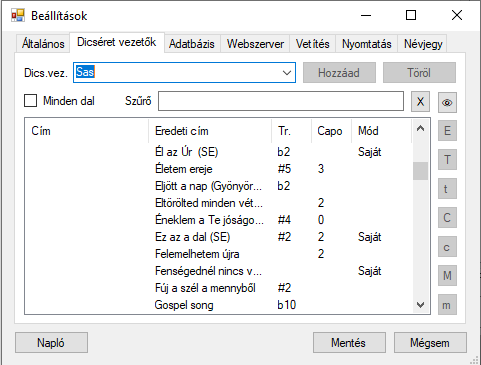 The PraiseProjector uses a ChordPro-based database that allows you to store chords beyond the lyrics.
This format is widely used, and PraiseProjector includes a WYSWYG editor. It not only stores chords but also interprets them, so songs can be transposed even during live performance.
Since the desktop projector contains a built-in web server, it can connect to tablets and phones over local networks or the internet, effectively turning them into digital sheet displays.
The PraiseProjector uses a ChordPro-based database that allows you to store chords beyond the lyrics.
This format is widely used, and PraiseProjector includes a WYSWYG editor. It not only stores chords but also interprets them, so songs can be transposed even during live performance.
Since the desktop projector contains a built-in web server, it can connect to tablets and phones over local networks or the internet, effectively turning them into digital sheet displays.
PraiseProjector can store setlists and individual leader or musician preferences, including preferred key and capo position for specific songs.
Because multiple song versions can be stored, personal version preferences can also be recorded.
PraiseProjector can be used without internet to access its core functionality, but to unlock its full potential you need at least a local network, which can be provided by a WiFi router (or even a PC with WiFi).
Its real strength, however, is online collaboration. When internet is available, no dedicated PC is required on the client side.
A tablet, phone, or any device with an HTML5-compatible browser is enough, even a smart TV.
One client can act as a leader and select the current song from the database or a prepared list, and adjust the key as needed. Other displays follow these changes automatically. This means the projector operator no longer has to search for each song manually, only mark the currently sung section. On request, the active text part can also be highlighted on client devices.
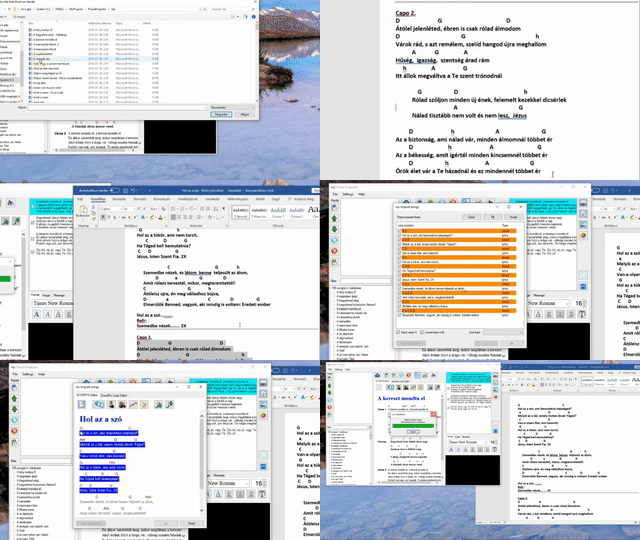 If Microsoft Word* is available on your PC, the Windows version of PraiseProjector* can import text-based files in several formats (e.g. HTML, DOC, RTF, PDF, TXT).
During this wizard-like workflow, the app guides you through importing "chord sheet" style songs, automatically detects chord lines, attempts to identify the chord notation used, and normalizes it.
In the best case, you only need to review and confirm the steps, then optionally refine structure and metadata to your preference.
If Microsoft Word* is available on your PC, the Windows version of PraiseProjector* can import text-based files in several formats (e.g. HTML, DOC, RTF, PDF, TXT).
During this wizard-like workflow, the app guides you through importing "chord sheet" style songs, automatically detects chord lines, attempts to identify the chord notation used, and normalizes it.
In the best case, you only need to review and confirm the steps, then optionally refine structure and metadata to your preference.
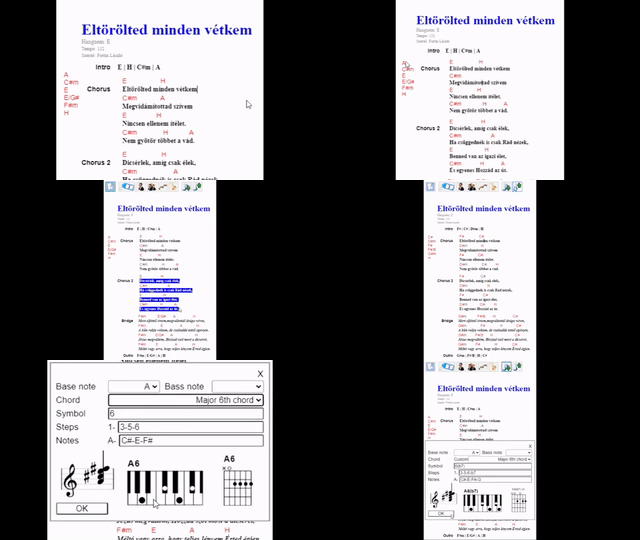 PraiseProjector does not require users to know the ChordPro format or follow its syntax rules while editing.
Similar to a modern word processor, users can see songs in near-final form while editing, place chords with drag-and-drop, and edit metadata without learning ChordPro codes.
PraiseProjector does not implement every feature of full ChordPro, but it interprets recorded chords and provides several convenience features for placing and editing them.
PraiseProjector does not require users to know the ChordPro format or follow its syntax rules while editing.
Similar to a modern word processor, users can see songs in near-final form while editing, place chords with drag-and-drop, and edit metadata without learning ChordPro codes.
PraiseProjector does not implement every feature of full ChordPro, but it interprets recorded chords and provides several convenience features for placing and editing them.
Automatic Intelligent Text and Cutting in the screenings offline (for external monitor) or online (for another device).
Set custom song information detail, chord format display, transposition or even CAPO use.
Automatically simplifies chords or shows them for keyboard or string instruments
With the help of an online database, the song collection can be synchronized between devices or available at any time on the Internet.
Yes. While the primary goal of the public song database is to support small Christian congregations, the software can also be used for non-religious content. Song categorization is still being improved, but the plan is to support clear categories and better filtered search so everyone can find what they need.
There is one now. PraiseProjector 2.0 desktop releases are available at /releases/electron, including cross-platform packages.
If you prefer not to install anything, you can use it directly in a browser as a PWA at /webapp.
PraiseProjector is free and intended to stay that way. (It would be difficult to charge for it anyway, given that its source code is public.)
However, running the project already involves costs, such as the domain name and server hosting. Anyone who wishes to make a voluntary donation toward these costs, or simply support the developer and his family 😉, may do so here, but there is no expectation to do so, and it does not affect use of the software in any way.
Code-signing certificates involve recurring costs and are not currently available for every release. As a result, the operating system may display a warning during installation or an update.
There are two reasons for this:
That said, if you would like to contribute, feel free to reach out. Documentation and web design help are especially valuable.
The goal is to maintain a high-quality shared collection. In practice, unrestricted editing often leads to inconsistent formatting and avoidable mistakes. For that reason, permission controls were introduced so enthusiastic but less experienced contributors cannot unintentionally break other people's work.
A moderation and quality-control workflow is currently being improved, and I will share more details soon.
Desktop packages are available for Windows, Linux, and macOS. The macOS build is currently published as a ZIP package (mac.zip) on /releases/electron.
macOS package signing is still limited, so on first launch you may need to use "Open" from the context menu or allow the app in system security settings.
On a Mac: download mac.zip, extract it, move the app bundle into Applications, then start it from there.
If macOS blocks the first run, right-click the app and choose "Open", or allow it from System Settings → Privacy & Security.
Yes. The same unified PraiseProjector application is available as an Android package from Google Play. You can switch between the full and simplified client views inside the app; there is no separate mobile client.
I do not currently have capacity to proactively test every browser. Fortunately, Chromium-based compatibility has become widespread, so most modern browsers work well.
If you need support for a specific browser that currently does not work, contact me and I will do my best to help.
There is. I have built several solutions for this already. General MIDI controller support is also planned, including wired and wireless (e.g. Bluetooth) connection options.
First of all, thank you for your offer.
Of course, contact me as a first step with the form at the bottom of the page.
Because the site started from a marketing-style HTML template, and I reused many of its original elements. I agree this is not always the most practical style.
During the development of the application, I built it on only open source, free -use libraries in addition to my own development, and the information panels for each application component are included in the license -related information.
The application itself does not contain the text or chord of a single song, which are brought to by users to the databases they upload.To the best of my knowledge, this has no legal restriction, At least a lot of domestic and foreign "sheet music" with similar information content (eg. Dicsőítők Portálja or Ultimate Guitar) is open and publicly available on the Internet for everyone. However, if anyone had a problem with their composition to be available on the online interface of the Praiseprojector nonprofit, the following contact option is to be addressed.